Chapter 12 · Maintenance
Rental maintenance: what to budget and when things wear out
Plan the routine work and keep cash for the work you cannot schedule.
By Dan D’Ambrosio, Founder, Plenteous; Broker-in-Charge, Plenteous Management. Fourth quarter 2026 edition · Updated · Sources reviewed
The short answer
Plan the small work, such as heating and air service, gutter cleaning and termite inspection, and keep cash for the repairs you cannot schedule. The guide's budget allows $1,650 a year for routine repairs plus $1,200 for major replacement funding, adjusted for the age and condition of the roof and major equipment.
Carl and the Hendersons are composite owners facing the same problem: a water heater leaks late on Friday. The combined plumbing and water-damage repair is $1,900. Carl needs to find the money; the Hendersons already have an accessible reserve. The bill is the same. Their ability to respond is different.
First protect people and stop damage safely. Then document the problem, notify the appropriate professionals and arrange the repair. Preventive service can reduce avoidable failures, but no schedule makes equipment last forever. The examples below show what to plan, not guaranteed savings.
| Work to plan | Example cost | Purpose |
|---|---|---|
| Heating and air service | $150-250 | Find problems and keep equipment operating properly. |
| Gutter cleaning | $150-300 | Keep water moving away from the roof and foundation. |
| Water heater service | $100-150 | Follow the unit’s service instructions and inspect for leaks. |
| Dryer vent cleaning | $100-150 | Keep exhaust clear and reduce an avoidable fire hazard. |
| Termite inspection / bond | $300-500 / year | Review inspection, treatment and coverage terms. |
Illustrative planning ranges from the guide, not current local quotes. Scope, frequency and price depend on the property and provider; obtain written estimates.
What wears out, and when
Record condition and replacement quotes as well as age.
The worked budget allows $1,650 a year for routine repairs plus $1,200 for major replacement funding. Those are starting assumptions. A nearly new house and one with an old roof need different plans. Record ages, condition and current replacement quotes; update the funding target as you learn more.
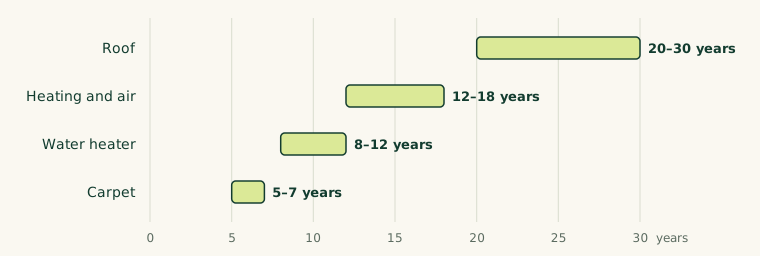
| Item | Range | Actual age |
|---|---|---|
| Roof | 20-30 years | |
| Heating and air | 12-18 years | |
| Water heater | 8-12 years | |
| Carpet | 5-7 years |
For nonurgent work, compare written scopes and quotes when the cost justifies it. Ask about labor, materials, diagnostic charges, warranties and any markup. For an urgent problem, safe, prompt action may matter more than obtaining another bid.
Repair-or-replace is a judgment about condition, remaining service, reliability, warranty and total cost. A costly repair on old equipment deserves a replacement quote; a simple percentage rule should not make the decision for you. Tell the tenant what will happen and when, then confirm the work was completed.
Ranges are planning assumptions, not warranties or tax depreciation schedules. Materials, installation, use and maintenance affect actual life.
Related questions
How long do a roof, heating and air system and water heater last?
The guide uses illustrative planning ranges: a roof 20 to 30 years, heating and air 12 to 18 years, a water heater 8 to 12 years and carpet 5 to 7 years. Materials, installation, use and maintenance affect actual life.
All chapters
Part one / The foundations
What you are really getting into
The opportunities, the responsibilities, and the preparation that gives you choices.
Part two / The numbers
Make the numbers yours
A worked budget, three financing scenarios, a difficult year, and two worksheets for the decision in front of you.
Part three / Running it well
Running it well
The life of a tenancy in the order it happens, the owner’s calendar, and the page to open when something breaks.