Chapter 07 · What a rental actually pays
What a rental actually pays: a worked Upstate example
An illustrative $240,000 house renting for $1,650 a month.
By Dan D’Ambrosio, Founder, Plenteous; Broker-in-Charge, Plenteous Management. Fourth quarter 2026 edition · Updated · Sources reviewed
The short answer
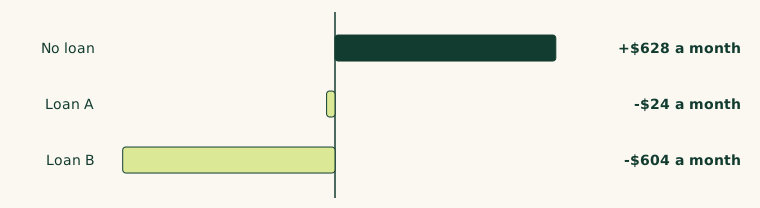
In the guide's example, a $240,000 house renting for $1,650 a month produces $8,740 of net operating income and $7,540 after replacement funding, before loan payments. With no loan that is about $628 a month. A $150,000 loan at 3.25% leaves -$24 a month, and $190,000 at 6.75% needs $604 a month of support.
This planning example assumes a two-year tenancy, one vacant month between tenants, and professional management. Irregular costs are spread across years. The amounts are rounded assumptions, not a forecast, a market quote or Plenteous's fee schedule. Replace them with figures for your address.
| Item | Amount |
|---|---|
| Scheduled rent$1,650 x 12 months | $19,800 |
| Vacancyone month every two years | -$825 |
| Management8% of collected rent | -$1,520 |
| Leasinghalf a month, every two years | -$410 |
| Renewal$250, every two years | -$125 |
| Routine maintenance and repairs | -$1,650 |
| Preparation between tenants$1,500, every two years | -$750 |
| Rental property taxesillustrative address | -$4,180 |
| Landlord insurance | -$1,600 |
| Net operating income | $8,740 |
| Major replacement funding$100 a month | -$1,200 |
| Cash plan before loan payments | $7,540 |
Net operating income (NOI) is rent less vacancy and operating costs, before debt payments, major replacement funding and income tax. Here it is $8,740 a year. That is a starting point for comparing the property, not the amount you can safely withdraw.
Next, earmark $1,200 a year for major replacements. That leaves $7,540 before debt payments. The $1,200 remains your cash until spent; funding the reserve is not itself an operating expense or an income-tax deduction.
Before income tax. Add any other costs for your address, including association dues, owner-paid utilities or services. The replacement allowance must reflect the condition and age of your systems.
One house. Three outcomes.
Monthly cash after the same operating budget and replacement funding.
Subtract principal and interest only. Property taxes and insurance are already in this budget; subtracting a full escrowed mortgage payment would count them twice. Use the actual payment and remaining term shown on your loan records.
| Scenario | Principal + interest | Per month | Per year |
|---|---|---|---|
| No loanOwned without debt | $0/month | +$628 | $7,540 |
| Loan A$150,000 balance / 3.25% fixed | $652.81/month | -$24 | -$294 |
| Loan B$190,000 balance / 6.75% fixed | $1,232.34/month | -$604 | -$7,248 |
Both loans are fixed-rate and fully amortizing, with 360 monthly payments remaining. Annual principal and interest: Loan A, $7,834; Loan B, $14,788.
A loan can turn a property with positive operating income into one that needs monthly support. Know that amount before you commit. Build your own budget on the worksheets, then test a more expensive year.
Loan payment figures exclude taxes and insurance, which were deducted in the budget above. Cash figures are before income tax and rounded independently to the nearest dollar.
Four ways to read the year
The same house and Loan A. Each measure answers a different question.
Cash, debt reduction, property values and taxes are different parts of ownership. Keep them separate when deciding whether the property meets your needs.
01 / Cash plan
-$294
Per year after funding
Before earmarking cash: +$906. Setting aside $1,200 for replacements leaves a $294 gap. The earmarked money remains yours until spent.
02 / Debt reduction
$3,003
Principal repaid / first 12 months
Part of the loan payment reduces the balance you owe. It builds equity through debt reduction; it is not cash available to spend.
03 / Value change
Three possibilities
| Value rises 3% | +$7,200 |
|---|---|
| Value stays flat | $0 |
| Value falls 3% | -$7,200 |
Hypothetical changes on a $240,000 value. No forecast or selling costs are included.
04 / Tax effects
Not estimated
Tax treatment depends on your basis, deductions, ability to use losses and eventual sale. A deduction does not automatically produce cash in the same year. Have your tax adviser model your situation.
These figures are not a combined return calculation. Moving cash into a replacement fund is an allocation, not an operating expense or new income. Actual replacements and selling costs would also affect the result.
Planning tool / The cash cushion
How much cash to keep
Start with obligations. Then allow for the property and your other commitments.
Three to six months of fixed costs can be a starting point. It is not a universal target. An older house, uncertain income or several rentals may call for more.
| Cost | Per month |
|---|---|
| Principal + interest | $652.81 |
| Property taxes | $348.33 |
| Insurance | $133.33 |
| Fixed monthly costs | About $1,134 a month |
Three to six months
$3,400-$6,800
A starting range, before other commitments and known near-term work.
Add other committed expenses and known work such as an aging roof. Existing replacement savings are part of your cash balance: count them once and preserve their purpose. A tenant's security deposit is not your reserve.
| Item | Amount |
|---|---|
| Annual cash before new replacement funding | +$906 |
| One extra vacant month beyond the base budget | -$1,650 |
| Unexpected repair beyond the repair allowance | -$3,000 |
| Annual result before new replacement funding | -$3,744 |
| If the $1,200 replacement contribution continues | -$4,944 |
This is an annual budget result, not automatically the amount of new money you must deposit. Existing reserves may pay the costs. The test conservatively ignores any management-fee savings during vacancy; it is not a worst-case scenario.
For the growing investor
Before buying the next house
Review the whole portfolio before adding another door.
Put every current home and the proposed purchase on the same annual basis. Judge the next purchase by what it does to the whole portfolio.
Use comparable numbers
Rent after vacancy, less recurring operating costs, is net operating income. Use consistent allowances for management, taxes, insurance and repairs. Subtract actual principal and interest, then major replacement funding. Avoid counting escrowed taxes and insurance twice.
Test overlapping problems
Model two vacant homes and an unexpected repair in the same month. Look for shared risks: one local job market or several roofs and heating systems reaching replacement age together. Plan how to restore spent reserves.
Protect the cash cushion
Calculate cash left after the down payment, closing costs and initial repairs. Compare it with all your homes' needs. Cash earmarked for a roof is already in your balance; do not also count it as an unrestricted cushion.
Check your capacity
Record the hours your homes require. Decide who will cover leasing, urgent calls, inspections and absences as you expand. Include the cost of extra help. Weigh available cash and workload alongside income.
| Property | Operating income / year | Principal + interest / year | Replacement funding / year | Cash after funding / year | Cash after purchase |
|---|---|---|---|---|---|
| Home 1 | |||||
| Home 2 | |||||
| Home 3 | |||||
| Home 4 | |||||
| Home 5 | |||||
| Next | |||||
| Total |
Cash after funding = operating income - principal and interest - replacement funding.
Shared cash left: Post-purchase balances include replacement funds. Count shared cash once.
Related questions
How much cash reserve should a rental owner keep?
Three to six months of fixed costs can be a starting point. It is not a universal target: an older house, uncertain income or several rentals may call for more. In the guide's Loan A example, that starting range is $3,400 to $6,800.
What is net operating income on a rental?
Rent less vacancy and operating costs, before debt payments, major replacement funding and income tax. In the guide's example it is $8,740 a year: a starting point for comparing the property, not the amount you can safely withdraw.
Should I subtract my whole mortgage payment from rental income?
Subtract principal and interest only. When property taxes and insurance are already in the budget, subtracting a full escrowed mortgage payment would count them twice.
All chapters
Part one / The foundations
What you are really getting into
The opportunities, the responsibilities, and the preparation that gives you choices.
Part two / The numbers
Make the numbers yours
A worked budget, three financing scenarios, a difficult year, and two worksheets for the decision in front of you.
Part three / Running it well
Running it well
The life of a tenancy in the order it happens, the owner’s calendar, and the page to open when something breaks.